01 / The question
How sedentary is the U.S. population?
A wrist accelerometer records movement continuously, but it does not directly say whether a person is sitting, sleeping, standing, or not wearing the device.
This project builds those behavioral labels before estimating waking sedentary time. The analysis uses NHANES 2011–2014 because it pairs nationally representative sampling with week-long wrist accelerometry. Survey weights then turn participant-level estimates into population-level results.
Built the analysis workflow, joined posture and sleep predictions, derived participant-level sedentary measures, implemented survey-weighted estimation, and produced the manuscript tables and figures.
02 / Methodology
From 80 Hz signals to hours per day.
Prepare signals
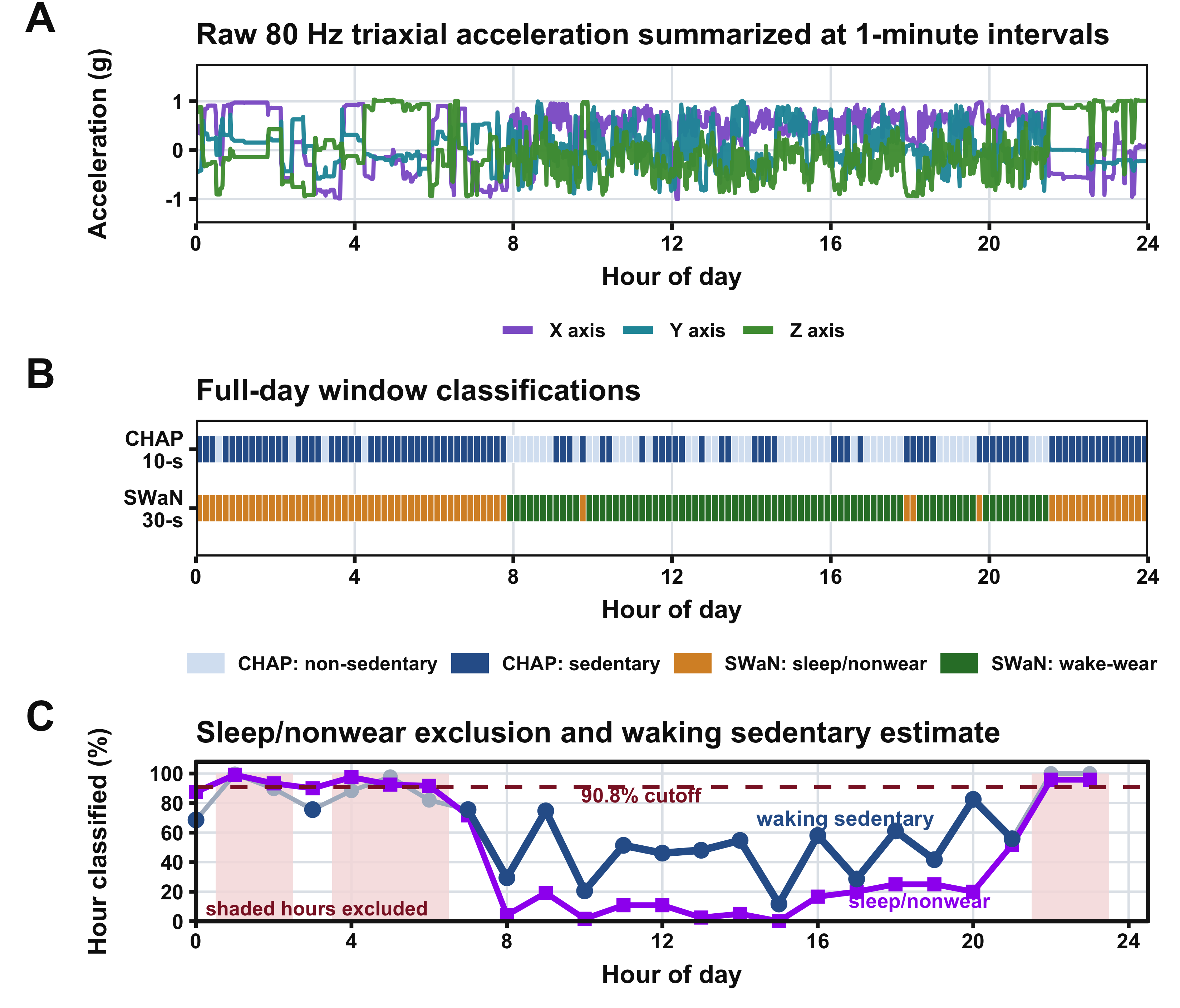
Align raw wrist acceleration with participant records and quality-control valid wear days.
Classify posture
Use CHAP deep-learning predictions to identify sitting or lying posture at the epoch level.
Identify sleep
Combine SWaN sleep/wear predictions with a calibrated cutoff informed by self-reported sleep.
Aggregate
Convert epoch labels into hourly and participant-level waking sedentary time.
Estimate
Apply NHANES survey weights, strata, and primary sampling units to obtain nationally representative means and confidence intervals.
03 / Findings
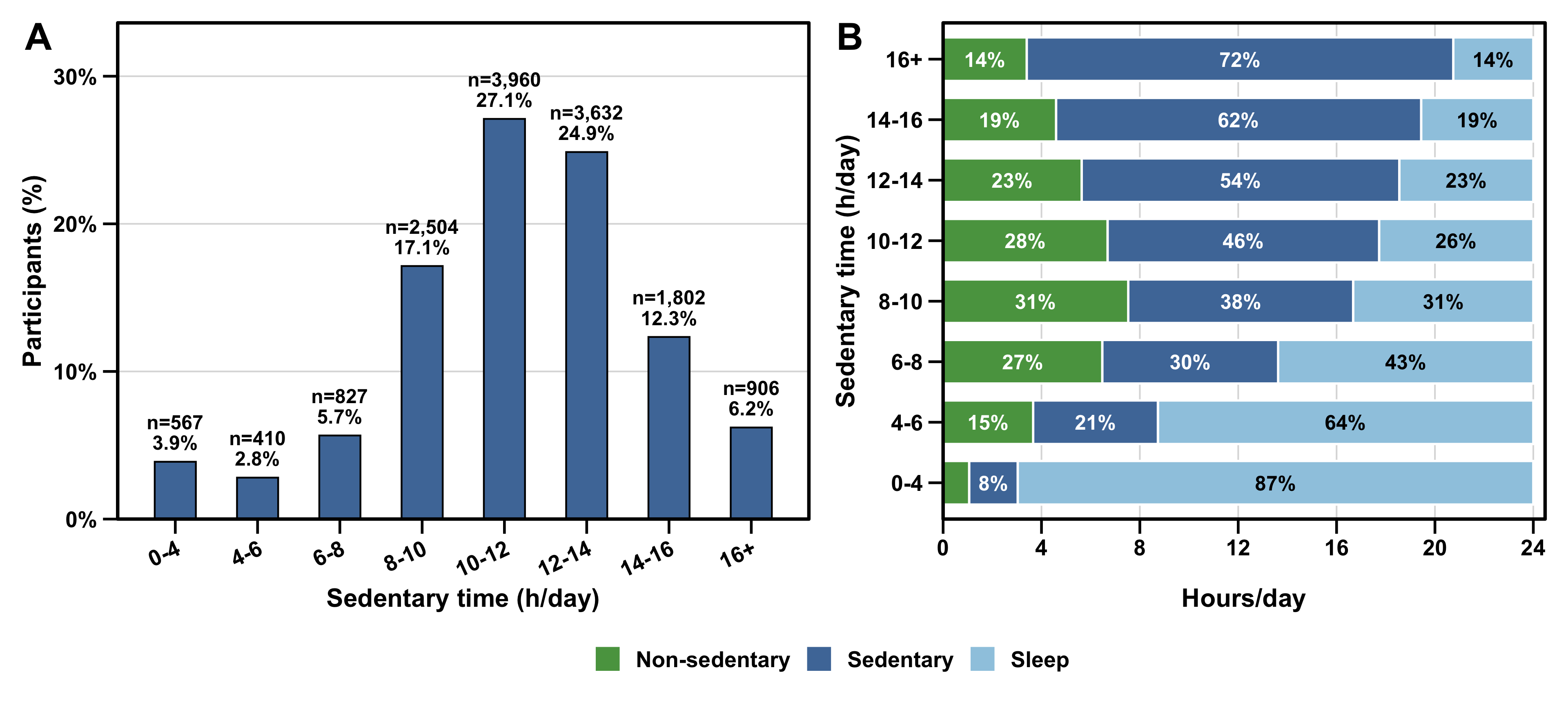
Waking sedentary time averaged 11.35 hours per day.
95% CI: 11.26–11.44 hours per day
95% CI: 16.99–17.19 hours per day
Men aged 65+; women aged 65+ averaged 12.89 h/day
The pooled estimate changed modestly across survey cycles: 11.46 hours per day in 2011–2012 and 11.25 hours in 2013–2014. Sedentary time rose with age in both men and women, from roughly 10 hours among participants under 18 to approximately 13 hours among adults 65 and older.
| Group | Men, mean (95% CI) | Women, mean (95% CI) |
|---|---|---|
| All ages | 11.48 (11.35, 11.62) | 11.22 (11.12, 11.33) |
| Under 18 | 10.54 (10.35, 10.73) | 10.20 (10.03, 10.36) |
| 45–64 | 11.93 (11.72, 12.14) | 11.69 (11.51, 11.86) |
| 65 and older | 13.52 (13.33, 13.72) | 12.89 (12.62, 13.15) |
04 / Figures & tables
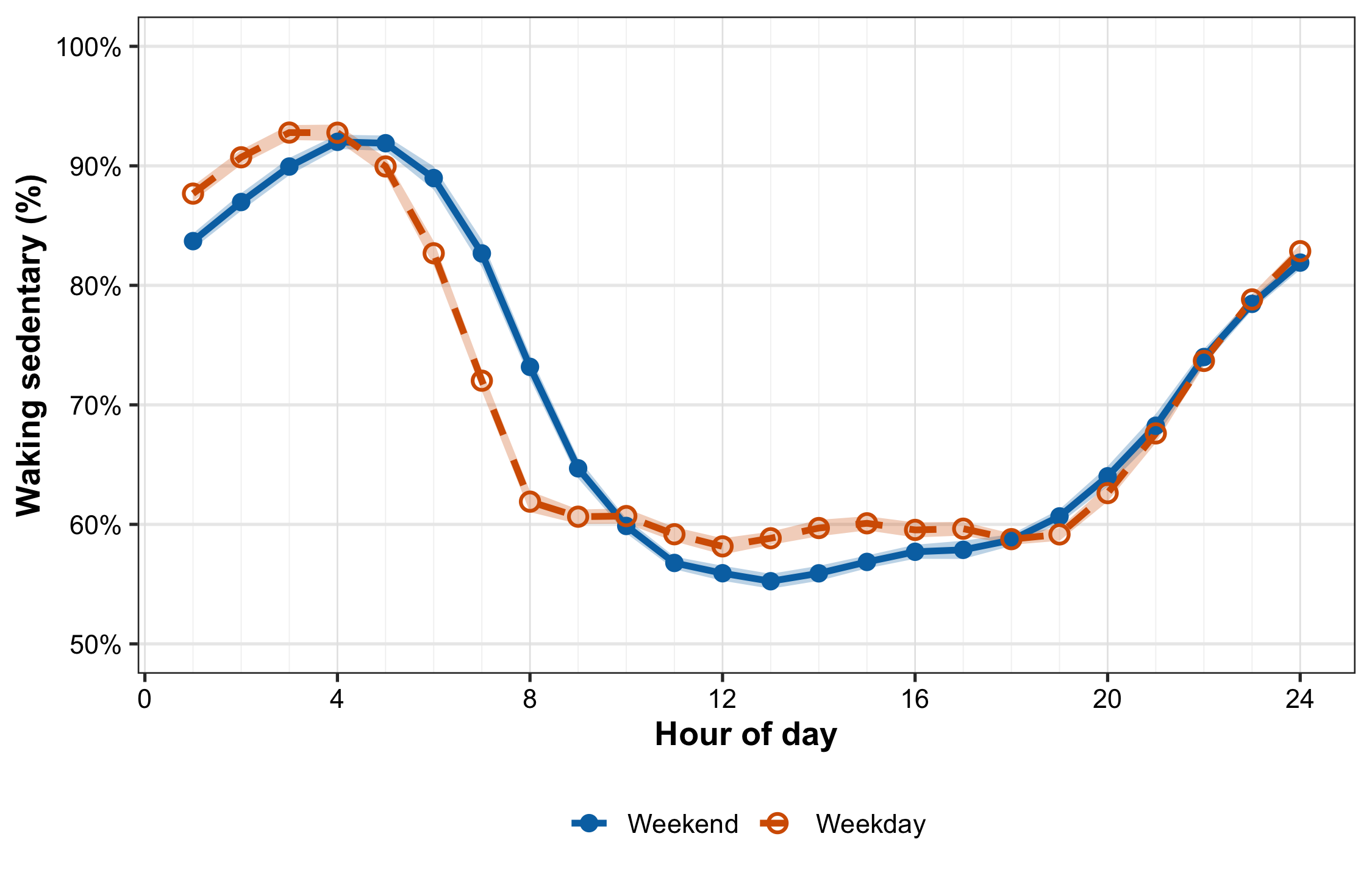
When sedentary time occurs matters too.
05 / Interpretation
What the estimate does—and does not—mean.
Classification is still measurement.
The final estimate depends on posture and sleep classifiers, valid-wear rules, and the selected sleep calibration cutoff. Survey weights address the NHANES sampling design, but they do not remove classification error. The repository therefore includes cutoff-sensitivity analysis, quality-control outputs, and cycle-specific estimates.